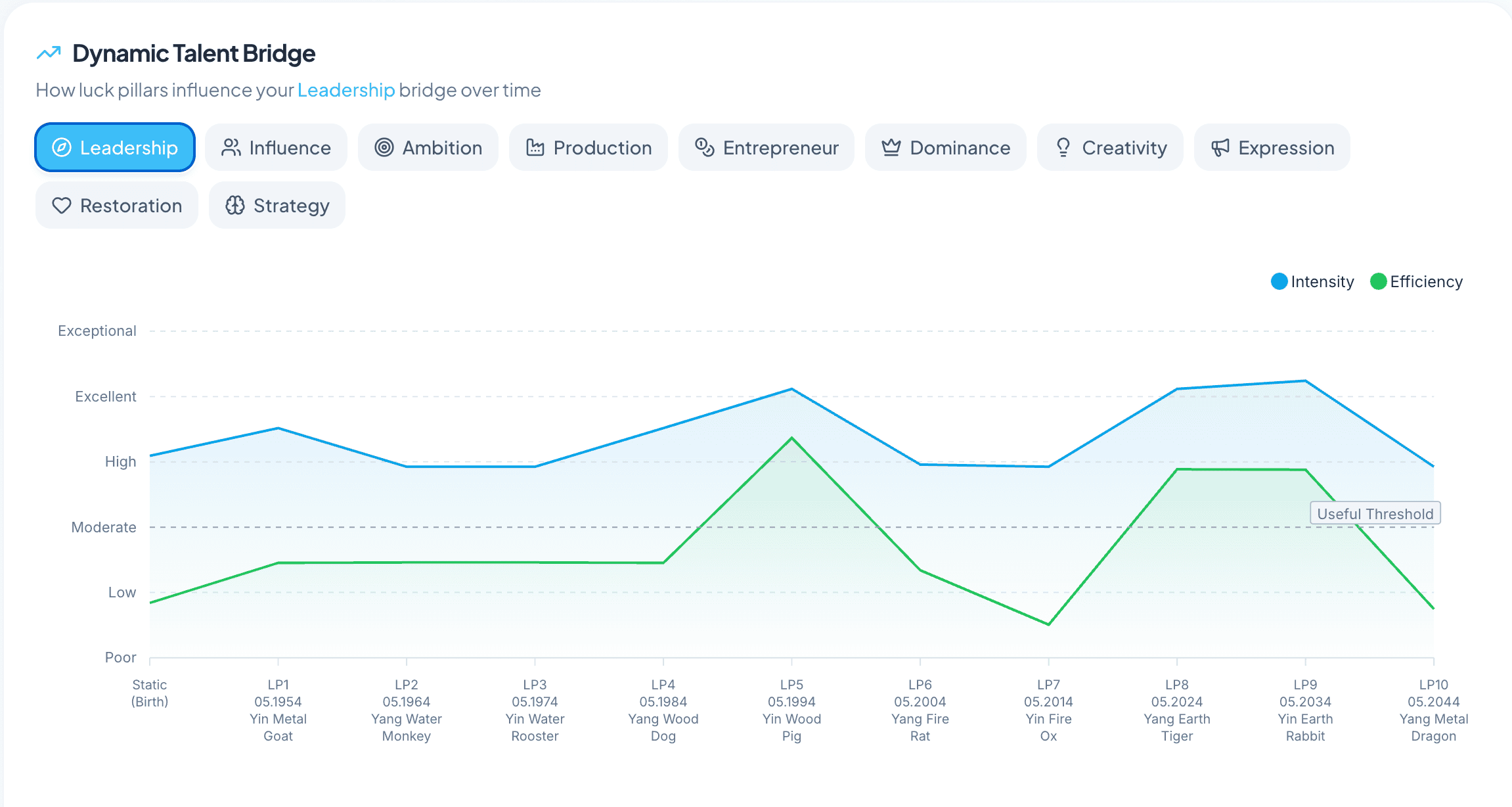
Most of you are familiar with Talent Bridge, our popular feature that was first introduced…
Your Birth Chart Is Not Your Soul
 Locating the Birth Chart Within the Architecture of the Human Being
Most people come to BaZi asking a simple question: what does my Chart say about me? But beneath that question lies a deeper one that nobody usually asks: What kind of information does a birth Chart actually contain? What layer of reality is it reading?
That question matters. Because if you don’t know what a tool is measuring, you’ll either expect too much from it or dismiss it entirely. BaZi deserves neither.
This post tends to place BaZi precisely, using Rudolf Steiner’s framework of the human being as a starting point. It maps it against the Vedic tradition, alongside which BaZi itself grew. The conclusion is straightforward: BaZi is a map of the nervous system. And once you understand what that means, the whole system makes a different kind of sense.
Three Layers of a Human Being
Rudolf Steiner, the Austrian philosopher and founder of Anthroposophy, described the human being as three distinct but interpenetrating layers. This isn’t mysticism for its own sake. It’s a structural map, and a surprisingly precise one.
The Vedic tradition uses almost identical architecture. Steiner himself engaged deeply with Indian philosophy before developing his own Western esoteric framework. The resemblance isn’t a coincidence.
Here’s how the three layers break down:
Spirit (Geist)
The eternal, unchanging dimension. Steiner’s I, the individuated spiritual core that persists across lifetimes. In Vedanta, this is Atman. It doesn’t have a birth Chart because it doesn’t have a birthday. It exists before incarnation and after death. No system can map it directly; it can only point toward it.
Soul (Astral Body)
The mediating layer. Receives impulses from the spirit above and impressions from the body below. Carries desires, emotions, memory, and individual character across a lifetime. In Vedanta, roughly, the antahkarana is the inner instrument. It’s real, it’s personal, but it’s temporary. It forms at birth and dissolves at death.
Nervous System (The Interface)
This is where BaZi lives. Physically material, neurons, electrochemical signals, measurable biology, but functionally astral. The nervous system’s entire purpose is perception, sensation, and response: astral qualities housed in physical tissue. Steiner called it the physical instrument of the astral body. It’s the hardware the soul runs on.
Physical Body
Pure matter. Bones, organs, blood. Processes that run without consciousness, such as digestion, cellular repair, and immune response. The densest layer. It follows physical laws completely. BaZi doesn’t map this level directly but rather indirectly, through a connection between the nervous system and the body (its physical organs). Hence, we say that Wood represents the liver, gallbladder, and related organs. In simple terms, a particular segment of the nervous system (Elements) is communicating with a particular segment of the body (Organs).
Where BaZi Sits, and Why
BaZi is built on five elements that cycle through the seasons. Metal, Water, Wood, Fire, Earth, each with its own quality of energy, its own mode of movement. These aren’t metaphors. They’re descriptions of how energy actually behaves in nature, and by extension, in us.
The nervous system is the biological system that most closely mirrors this. Every other organ has a fixed job. The liver detoxifies. The heart pumps. But the nervous system’s job is to respond, to receive information from the environment and generate an appropriate reaction. It’s fundamentally relational, dynamic, and pattern-sensitive. Exactly what the five elements describe.
BaZi doesn’t tell you who you are.
It tells you how you’re wired, which shapes everything.
Different Day Masters aren’t personality types in the pop-psychology sense. They’re genuinely different nervous system architectures. Yin Metal’s precision and hypersensitivity to dissonance. Yang Wood’s directional momentum doesn’t stop to check if others are following. Yang Fire’s radiant dispersal, energy going outward constantly, sometimes faster than it can be replenished. These aren’t invented categories. They describe real, observable differences in how people perceive and respond.
What BaZi maps, specifically, is the configuration of that nervous system at birth, the temporal matrix you arrived in. The season, the elemental balance, the interactions between pillars. That configuration sets the baseline for how your instrument processes experience for this lifetime.
A Vertical Chain of Causation
Once you place BaZi within the nervous system layer, the system’s overall logic becomes cleaner. There’s a direction of causation running from top to bottom:
↓
The astral body forms, carrying intention, karma, and character
↓
The nervous system crystallizes at birth; the Chart is fixed here.
↓
Physical life unfolds through that wiring.
In Vedantic terms, BaZi maps the prarabdha karma, the portion of accumulated soul history that has been activated for this specific lifetime. Not the totality of what the soul carries. Just the slice currently in motion, crystallized into a nervous system configuration.
In Steiner’s terms, the Chart describes the conditions the spirit volunteered to work through. The specific friction and resistance that were chosen, consciously, before birth, as the developmental material for this incarnation. Fate, but chosen fate.
This is why the Chart is accurate but not ultimate. It’s reading a real layer; the nervous system genuinely determines how you experience life. But it’s a downstream layer. It’s the crystallization of something that originated higher up. It doesn’t read our soul (as many astrologists would like to believe), but it reads our current physical manifestation of that soul, which, in one way, is a limited scope. Still, from a human perspective, it is actually a tremendously large one.
What This Means in Practice
Placing BaZi correctly changes what you expect from it — and what you do with it. Several things that might have seemed puzzling become straightforward:
- Why is BaZi accurate? Because the nervous system genuinely shapes how you process everything — relationships, work, stress, opportunity. Reading it accurately is reading something real and determinative.
- Why does timing work? Luck pillars and annual influences are changes in the astral environment — seasonal, cosmic currents — interacting with your fixed nervous system map. The BaZi Chart is the instrument. Time is what plays it.
- Why do some things stay fixed? Physical crystallization has inertia. You don’t easily rewrite your nervous system. Chart limitations are real. This is why working with your Chart — not against it — is almost always the right starting point.
- Why is transcendence possible but rare? Upstream can always influence downstream. When consciousness develops sufficiently — when the astral body is refined enough to carry genuine spiritual impulse — the nervous system’s configuration can be worked with rather than driven by. The Chart still describes the terrain. The walker is no longer entirely determined by it.
- Why does BaZi not read the soul directly? The soul’s deeper currents — will, growth, spiritual development — are upstream of what the Chart captures. BaZi sees the soul’s instrument, not the soul itself. That’s not a limitation. That’s precision.
The River and the One Who Watches It
BaZi shows you the river. The current, the depth, the seasonal patterns, where it floods, and where it runs dry. That’s genuinely valuable information. Most people spend their lives fighting the current without ever understanding what kind of river they’re in.
But the river is not the whole story. Something is watching the river. That something — Steiner’s I, Vedanta’s Atman, whatever framework you prefer — doesn’t appear in the Chart. It can’t. It’s upstream of everything the Chart can reach.
This is actually good news. It means the Chart is a map, not a sentence. It describes the nervous system configuration you’re working with — the specific wiring, the particular quality of instrument you have for this lifetime. Understanding that wiring clearly is the first step to using it well.
BaZi, practiced at its best, is not fortune-telling. It’s a form of self-knowledge precise enough to be actionable — situated exactly where knowledge needs to be situated to change how you live. Not so high it floats away into abstraction. Not so low that it reduces you to biology. Right at the interface. Right where you actually are.
Related Posts